

How to Build a Brand for the UAE Market: What Premium Clients Actually Expect
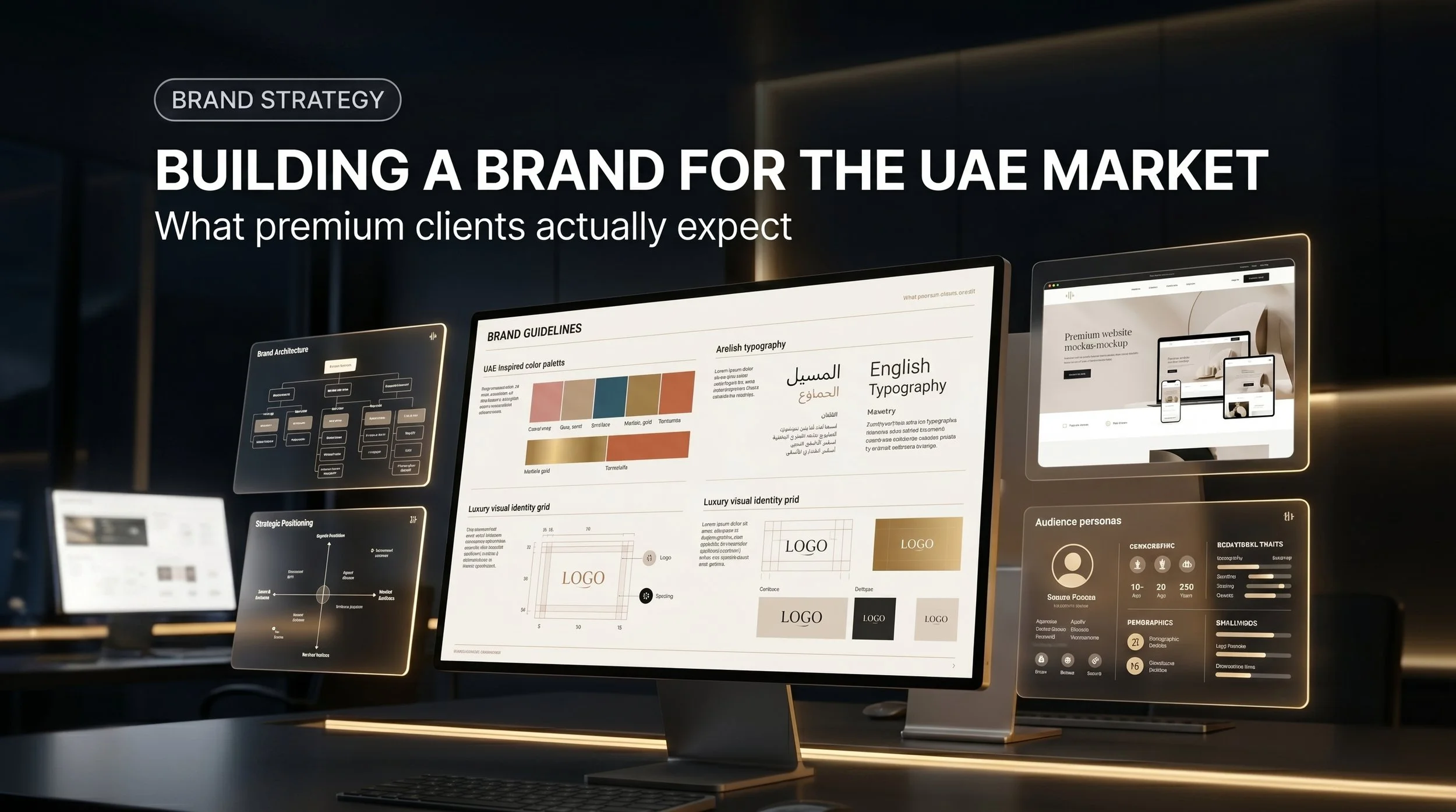
Building a brand for the UAE market is not the same as building a brand anywhere else in the world.
Dubai is a city where premium is the baseline. Where clients have seen everything. Where trust is built through visual credibility before a single conversation takes place. Where your brand needs to work for a client from London, Riyadh, Mumbai, and Moscow — simultaneously.
Getting this right requires more than good design. It requires understanding exactly what premium clients in this market expect — and building every element of the brand to meet that expectation.
Premium Clients Judge Before They Enquire
In the UAE, a high-value client will assess your brand completely before they ever reach out. They will look at your website, your Instagram, your Google presence, and how your business presents itself across every touchpoint.
If anything looks inconsistent, outdated, or below the standard they expect — they move on silently. There is no feedback. No second chance. They simply go to a brand that looks like it operates at their level.
This means your brand has one job before any sales conversation begins: to communicate that you belong in the same room as your ideal client.
The UAE Market Requires Cultural Intelligence
The UAE is one of the most diverse markets in the world. Your brand needs to feel premium and trustworthy across multiple cultural contexts simultaneously.
This means avoiding visual clichés that feel regional rather than global. It means typography that works in both Latin and Arabic scripts if your audience is bilingual. It means color choices that carry positive associations across cultures. It means photography and imagery that feels inclusive without being generic.
The strongest brands in Dubai feel simultaneously international and locally grounded. They do not try to be everything to everyone — but they speak a visual language that resonates across cultures.
Positioning Must Be Specific
The most common branding mistake in the UAE market is positioning that is too broad. "We serve all businesses." "Premium quality for everyone." "Your trusted partner."
These phrases mean nothing to a premium client. They have heard them thousands of times. They signal that the brand has not done the work of defining who it is actually for.
Specific positioning is magnetic. "We build brand identities for luxury and beauty businesses in the UAE." "We create AI-powered content for e-commerce brands scaling across the GCC." These statements immediately tell the right client that you understand their world.
Specificity does not limit your client base. It attracts the right ones.
Every Touchpoint Must Be Consistent
Premium clients notice inconsistency immediately. A beautiful website with a mediocre Instagram. A strong logo with weak typography in email signatures. Professional photography on the homepage and low-quality images in Stories.
Each inconsistency chips away at the perception of premium. And in a market where your client has dozens of alternatives at the same price point, perception is everything.
A complete brand system — with clear rules for how every visual and verbal element is used — is what keeps the brand consistent as the business grows, hires new people, and expands into new channels.
Brand Voice Is as Important as Visual Identity
How your brand sounds is as important as how it looks. The words you use, the tone you take, the way you handle enquiries, the language in your proposals — all of this is part of the brand.
In the UAE market, premium brand voice is confident without being arrogant, expert without being inaccessible, and warm without being casual. It speaks to the client as an equal, not as a vendor looking for approval.
How HOOQ Studio Builds Brands for the UAE Market
At HOOQ Studio, we have built brands for luxury, beauty, real estate, and technology businesses across Dubai and the GCC. We understand this market — its cultural complexity, its visual standards, its client expectations.
Every brand project starts with strategy: positioning, audience definition, competitive landscape, and brand architecture. Design follows strategy. Always.
The result is a brand that does not just look premium — it performs premium across every market it enters.
